
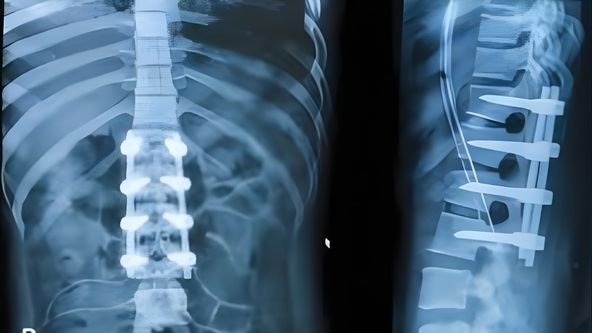
What is Lumbar Spinal Fusion?
Lumbar Spinal Fusion is a surgical procedure that permanently connects two or more vertebrae in the lower back. The goal is to eliminate movement between the vertebrae, which in turn reduces pain arising from instability, friction, or nerve compression. During the procedure, bone grafts, implants, screws, and rods are used to fuse the vertebrae into a single stable unit.
Over time, the bone graft naturally heals and fuses, similar to how a bone fracture heals. Because of this solid fusion, painful movement disappears, and the spine becomes stronger and more stable.
Lumbar Spinal Fusion is recommended only after thorough evaluation and when non-surgical treatments fail to provide relief.
Conditions Treated with Lumbar Spinal Fusion
Lumbar Spinal Fusion is performed to correct several lower back conditions. Some of the most common include:
1. Degenerative Disc Disease
Over time, spinal discs begin to wear out. This can lead to instability, inflammation, and chronic pain. Fusion stabilizes the affected segment and stops painful motion.
2. Spondylolisthesis
When a vertebra slips out of place, it can compress nerves and cause severe pain. Fusion holds the vertebrae together and restores alignment.
3. Spinal Stenosis
This occurs when the spinal canal narrows, leading to nerve compression. Fusion is combined with decompression surgery to provide long-term stability.
4. Herniated Disc (Repeated or Severe Cases)
If disc removal is necessary, fusion may be performed to maintain spinal support.
5. Spinal Fractures
Fusion stabilizes the spine after trauma or injury.
6. Spinal Tumors
After tumor removal, fusion helps maintain strength and alignment.
7. Abnormal Spinal Curvature
Conditions like scoliosis or kyphosis may require fusion to correct alignment.
8. Chronic Mechanical Back Pain
When pain arises from instability rather than nerve compression, fusion can provide lasting relief.
Why Lumbar Spinal Fusion is Recommended
Lumbar Spinal Fusion is suggested when:
Pain persists for more than 3–6 months
Conservative treatments fail to provide relief
There is evidence of spinal instability
Daily activities and movement are significantly affected
Nerve compression symptoms worsen over time
Mobility is limited due to structural defects
Spinal deformity needs surgical correction
Dr. Ankit Daware conducts detailed clinical examinations, imaging studies, and diagnostic tests to determine whether lumbar spinal fusion is the right option for each patient.
Benefits of Lumbar Spinal Fusion
Lumbar Spinal Fusion offers several long-term benefits, including:
1. Pain Relief
By eliminating motion between vertebrae, spinal fusion reduces chronic pain caused by instability or nerve compression.
2. Improved Mobility and Function
Although the fused segment no longer moves, overall mobility improves because pain is significantly reduced.
3. Enhanced Stability
Fusion strengthens the spine, making it easier to walk, bend, lift, and perform daily tasks comfortably.
4. Lasting Correction
It provides permanent correction for deformities like scoliosis and kyphosis.
5. Reduced Dependence on Painkillers
With pain healing over time, patients rely less on medications.
6. Improved Quality of Life
Most patients return to normal life, work, and physical activities after recovery.
Types of Lumbar Spinal Fusion Procedures
1. Posterolateral Fusion (PLF)
Bone graft is placed between the transverse processes of the vertebrae. Screws and rods are used to stabilize the spine.
2. Posterior Lumbar Interbody Fusion (PLIF)
The disc is removed from the back, and bone graft or cage is inserted into the disc space to achieve fusion.
3. Transforaminal Lumbar Interbody Fusion (TLIF)
A safer version of PLIF, TLIF uses a unilateral approach to reduce nerve retraction. It is one of the most commonly performed fusion techniques.
4. Anterior Lumbar Interbody Fusion (ALIF)
Approached from the front, the surgeon removes the disc and inserts a cage or graft. This allows access without disturbing spinal nerves.
5. Lateral Lumbar Interbody Fusion (LLIF / XLIF)
Performed from the side, this minimally invasive technique avoids major muscle disruption.
6. Minimally Invasive Lumbar Fusion
Advanced tools and small incisions reduce recovery time, blood loss, and post-surgical pain.
How the Lumbar Spinal Fusion Procedure Is Performed
Step 1: Preoperative Evaluation
Before surgery, patients undergo:
- X-ray
- MRI scan
- CT scan
- Neurological assessment
- Spine stability evaluation
- Blood tests and medical fitness checks
Dr. Ankit Daware explains the procedure, expected outcomes, and recovery guidelines before moving ahead.
Step 2: Anesthesia
The patient receives general anesthesia, ensuring complete comfort and pain control throughout the procedure.
Step 3: Incision and Exposure
Depending on the fusion technique, a small incision is made on the back, abdomen, or side.
Step 4: Disc or Bone Removal
Damaged discs, bone growths, or tissues compressing nerves are removed to create a stable environment for fusion.
Step 5: Bone Grafting
Bone graft material is placed between vertebrae to facilitate fusion. Grafts used may be:
- Autograft (patient’s own bone)
- Allograft (donor bone)
- Synthetic bone substitutes
Step 6: Implant Fixation
Screws, cages, and rods hold the spine in position until the fusion heals over several months.
Step 7: Closing the Incision
The incision is closed with sutures, and a sterile dressing is applied.
Recovery After Lumbar Spinal Fusion
Recovery plays a major role in achieving a successful outcome. With proper care, most patients recover well and experience long-term relief.
Hospital Stay
Most patients stay in the hospital for 2 to 4 days depending on the surgical method.
Pain Management
Post-surgical pain is managed with medications, ice therapy, and controlled movements.
Physiotherapy
Physiotherapy begins gradually:
Gentle walking
Strengthening exercises
Posture training
Core strengthening
Flexibility improvement
Return to Activities
Light activities: 2–4 weeks
Office work: 4–6 weeks
Driving: 4–8 weeks
Complete recovery: 3–6 months
Full fusion: 6–12 months
Dr. Ankit Daware provides a personalized recovery plan for each patient.
Preparing for Lumbar Spinal Fusion Surgery
Before surgery, patients are advised to:
Stop smoking
Maintain a healthy weight
Manage diabetes and blood pressure
Avoid blood-thinning medications
Improve core strength through light exercises
Follow all pre-operative guidelines provided by Dr. Daware
These steps help ensure safe surgery and faster healing.
Myths vs Facts About Lumbar Spinal Fusion
Myth 1: Fusion reduces all spinal movement.
Fact: Only the diseased segment is fused; overall motion remains largely unaffected.
Myth 2: Recovery takes years.
Fact: Most patients recover within months and experience major relief early on.
Myth 3: It is only for elderly patients.
Fact: Adults of all ages undergo fusion depending on their condition.
Myth 4: Pain will remain even after surgery.
Fact: Fusion is highly effective in relieving chronic pain caused by instability.