
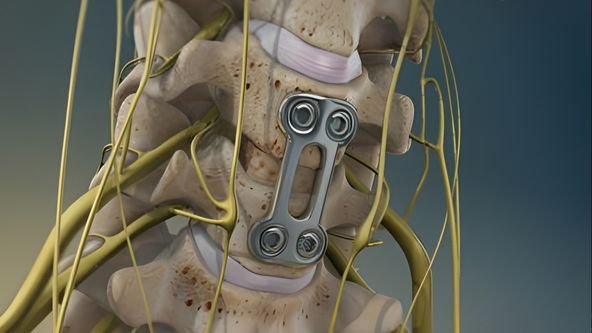
Anterior Cervical Spine Surgery – Relieve Neck Pain, Restore Mobility
Anterior Cervical Spine Surgery (ACSS) is an advanced procedure designed to treat long-standing neck pain, nerve compression, and spinal instability caused by conditions such as herniated discs, cervical spondylosis, spinal stenosis, or injury. In this minimally invasive technique, the surgeon approaches the spine from the front of the neck, allowing better access to the cervical disc and nerves while reducing muscle disruption, blood loss, and recovery time.
What is Anterior Cervical Spine Surgery?
Types of Anterior Cervical Spine Surgery (ACSS)
1. Anterior Cervical Discectomy (ACD)
Removal of a damaged or herniated disc through a small incision in the front of the neck to relieve pressure on nerves or spinal cord.
2. Anterior Cervical Discectomy and Fusion (ACDF) – Most Common
After disc removal, a bone graft or implant is placed to fuse two vertebrae. This stabilizes the spine and reduces nerve pain.
Used for: Disc herniation, nerve compression, neck pain radiating to arm.
3. Cervical Disc Replacement / Artificial Disc Surgery (ADR)
Instead of fusion, a mobile artificial disc is inserted to preserve natural neck movement.
Used for: Younger patients/active lifestyle, single-level disc disease.
Benefit: No fusion → less stress on neighboring vertebrae.
4. Anterior Cervical Corpectomy
Removal of the vertebral body and adjacent discs when compression is extensive.
Used for: Severe spinal cord compression due to trauma, tumors, or advanced degeneration.
5. Anterior Cervical Fusion Using Plate and Screws
Additional metal implants added for higher stability after ACDF or corpectomy.
Common Causes of Anterior Cervical Spine Surgery
1. Cervical Disc Herniation
The soft disc between neck bones slips or ruptures, pressing on nerves or spinal cord.
Symptoms: Neck pain, arm pain, tingling, weakness.
2. Cervical Spondylosis (Age-related Degeneration)
Wear and tear of discs, joints, and ligaments causing nerve compression.
3. Cervical Radiculopathy
Compression or inflammation of a spinal nerve root leading to radiating arm pain and numbness.
4. Cervical Myelopathy (Spinal Cord Compression)
Narrowing of spinal canal that presses on spinal cord — often requires early surgery.
Symptoms: Difficulty walking, loss of balance, reduced grip strength.
5. Trauma / Fractures
Accident or fall causing bone displacement or disc injury needing stabilization.
6. Cervical Spine Tumors
Benign or malignant growths causing compression.
7. Infections (Osteomyelitis / Discitis)
Infection damaging disc or bone requiring surgical debridement.
8. Failed Previous Spine Surgery
Persistent or recurrent symptoms after earlier procedures.
Symptoms of Anterior Cervical Spine Surgery
Neck-Related Symptoms
- Persistent neck pain that does not improve with rest or medication
- Stiffness and reduced range of motion
- Pain that worsens with movement, coughing, or sneezing
Nerve Compression Symptoms
- Radiating pain from neck to shoulder, arm, forearm, or fingers
- Numbness or tingling in arms or hands
- Burning or electric-like pain down the arm
- Difficulty lifting the arm or gripping objects (weakness)
Spinal Cord Compression (Myelopathy) Symptoms
- Loss of balance while walking
- Frequent falls or unsteady gait
- Weakness in both arms or legs
- Difficulty performing fine tasks (buttoning, writing)
- Bladder or bowel problems (in severe cases)
Symptoms After Trauma
- Severe pain after accident or fall
- Sudden weakness or numbness
- Limited neck movement or deformity
Emergency Management of Cervical Spine Conditions Requiring Anterior Cervical Surgery
When a spinal cord injury occurs, the first response plays a critical role in preventing further neurological damage.
Dr. Ankit Daware and his team follow global emergency guidelines such as:
-
Stabilizing the spine
-
Preventing movement
-
Maintaining adequate breathing
-
Rapid imaging (X-ray, CT scan, MRI)
-
Initiating medications if required
-
Early surgical intervention for unstable injuries
-
Transferring the patient to an intensive care setting
Timely treatment decreases complications and increases chances of neurological recovery.
Conditions Treated with Anterior Cervical Spine Surgery
Dr. Ankit Daware recommends ACSS for conditions such as:
✔ Cervical Disc Herniation
Soft disc material presses on nerves, causing neck and arm pain.
✔ Cervical Radiculopathy
Nerve compression leads to tingling, numbness, and radiating arm pain.
✔ Cervical Myelopathy
Spinal cord compression causing coordination problems and weakness.
✔ Degenerative Disc Disease
Age-related disc wear causing chronic pain.
✔ Cervical Spinal Stenosis
Narrowing of the spinal canal.
✔ Osteophytes (Bone Spurs)
Overgrowth of bone irritating nerves.
If conservative treatment such as rest, medications, physiotherapy, lifestyle adjustments, or injections fails, surgery becomes the best solution.
Diagnosis of Spinal Cord Injury
Accurate diagnosis helps determine the type, level, and severity of the injury.
Dr. Ankit Daware uses advanced diagnostic tools, including:
1. X-Ray
To detect fractures, dislocations, or spinal misalignment.
2. CT Scan
Offers detailed bone imaging, helps identify complex fractures.
3. MRI Scan
The most essential test to detect spinal cord compression, nerve damage, ligament injury, swelling, or bleeding.
4. Neurophysiological Tests
Such as EMG and NCV to check nerve conduction and muscle response.
5. ASIA Scale Classification
Used internationally to assess injury severity and predict recovery.
Accurate diagnosis ensures appropriate treatment planning.